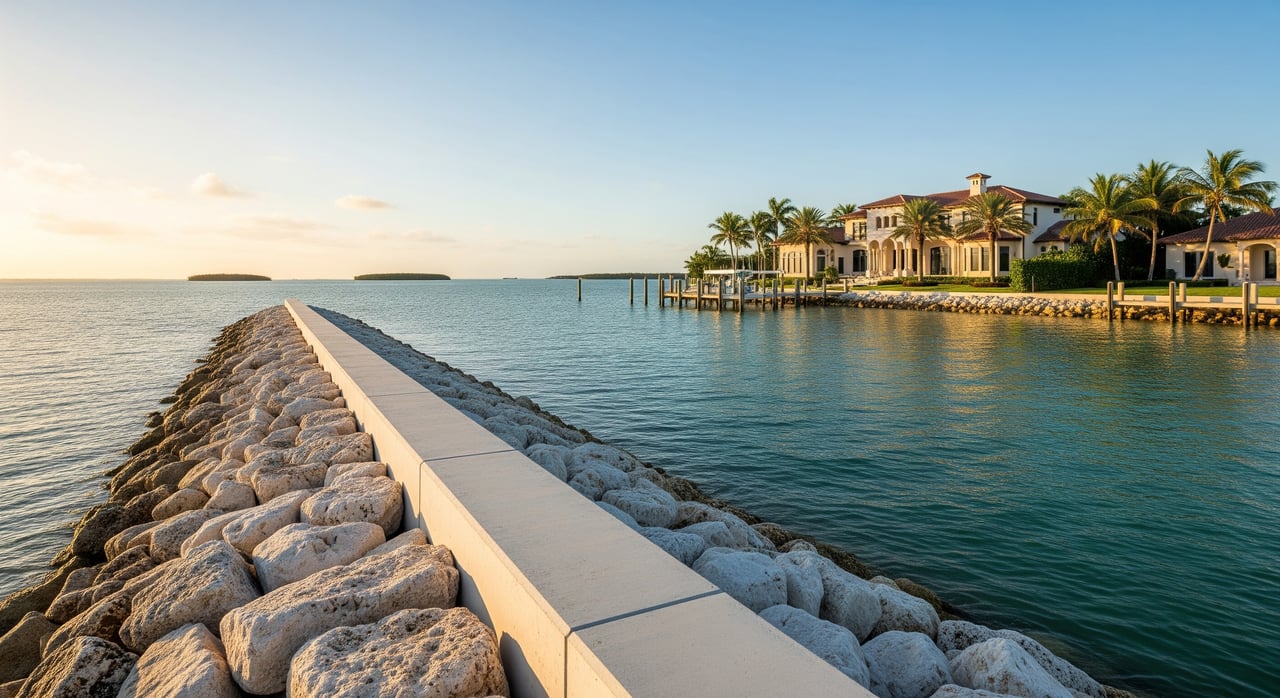
Buying or repositioning a waterfront asset in Port Royal or greater Naples can hinge on one line item: the shoreline. Seawalls and riprap are not just maintenance—they are capital strategy. If you are modeling offers or planning renovations, you need credible lifecycle ranges, realistic unit costs, and a permit path that protects your timeline. This guide gives you investor‑grade basics tailored to Port Royal and Collier County so you can budget with confidence and move faster once under contract. Let’s dive in.
Port Royal shoreline essentials
Seawalls are vertical structures that hold uplands in place and control erosion. Common materials include concrete, steel sheet pile, and vinyl. Riprap is rock placed on a slope to absorb wave energy and stabilize banks. In some natural settings, living shoreline approaches use plantings and softer materials, though high‑energy docking areas often require hard protection.
Local approvals in Port Royal typically involve the City of Naples, Collier County (if applicable), the Florida Department of Environmental Protection, and the U.S. Army Corps of Engineers for in‑water work. Early contact with planners helps determine if a seawall, riprap, a hybrid, or a living shoreline will be favored for your specific frontage.
Useful life by structure type
Plan your capital stack around practical lifecycle ranges. Actual service life depends on design, exposure, soils, and maintenance.
- Concrete seawall (cast in place, well designed): typical useful life 30 to 60 years. Major rehabilitation often appears at 20 to 35 years.
- Precast concrete panels on tiebacks: typical useful life 25 to 50 years. Panel or tieback renewal may arise at 20 to 40 years.
- Steel sheet pile with corrosion protection: typical useful life 20 to 40 years without robust protection and 40+ years with good coatings and cathodic protection. Plan anode checks or replacement every 10 to 20 years.
- Vinyl sheet pile: typical useful life 30 to 50 years in low‑abrasion, low‑UV conditions.
- Riprap revetment: design life 30 to 75 years when properly sized, keyed, and protected at the toe. Inspect every 5 to 10 years, with spot stone replacement as needed after storms.
For asset management, budget annual inspections and minor repairs as recurring OPEX at roughly 1 to 3 percent of initial capex per year. Expect a mid‑life capital intervention near 20 to 30 years for many seawalls.
Cost planning ranges in Naples
Unit prices in Port Royal vary with access, exposure, and permit complexity. Use these ranges for early underwriting, then validate with local bids.
- Seawall replacement (complete): $800 to $2,500+ per linear foot
- Riprap installation (keyed with toe protection): $200 to $900+ per linear foot
- Partial repairs or localized stabilization: $150 to $700 per linear foot
- Steel sheet pile installation: $500 to $1,800 per linear foot
- Design and engineering: 6 to 12 percent of construction cost
- Permitting and mitigation: $10,000 to $150,000+ depending on habitat impacts and permit type
- Dredging or sediment disposal if required: often $50,000 to $500,000+ based on volume and disposal
- Marine mobilization and staging: plan 10 to 30 percent of construction cost
Key cost drivers to watch
- Access and staging. Barge access and limited laydown space in Port Royal can move numbers quickly.
- Subsurface conditions. Deep silts, debris, or hard layers change the method and cost.
- Tie‑ins and adjacency. Walls that connect to neighbors or pass behind docks and utilities add complexity.
- Environmental factors. Mangroves, seagrass, and protected species can trigger mitigation.
- Permit path. A federal individual permit increases time and soft costs compared to a nationwide permit.
- Season and capacity. Storm season and contractor backlog can push short‑term pricing up.
Riprap on natural waterways
Regulators often encourage softer solutions where conditions allow. In natural or estuarine reaches, you may see preference for living shorelines or limited hard armoring. Riprap is commonly accepted where hard protection is necessary, and it is frequently used as toe protection or a transition in high‑energy or docked frontages typical of Port Royal.
Your actual allowance depends on shoreline classification, nearby biological resources like seagrass or oyster bars, the erosion mechanism, and recent local precedent. The best step is a pre‑application meeting to confirm whether riprap, a hybrid, or an alternative will be supported for your parcel.
Permit path and sequencing
Treat permitting as a parallel track to your acquisition. The right sequence reduces re‑design, delays, and change orders.
Step‑by‑step workflow
- Title and boundary review
- Confirm upland boundaries, bulkhead ownership, and any sovereign submerged lands issues.
- Topographic and bathymetric survey, with geotechnical reconnaissance
- Support design loads, riprap sizing, toe keying, and permit exhibits.
- Pre‑application meetings
- Meet with City of Naples, Collier County if applicable, FDEP, and USACE. Align on acceptable solutions and likely mitigation before final design.
- Design and permit drawings
- Structural details, erosion analysis, construction sequence, and environmental protection plan. Include any monitoring or mitigation plans.
- Permit submission and reviews
- City or County: plan 30 to 120 days for typical reviews.
- FDEP ERP or coastal permits: plan 60 to 180 days.
- USACE Section 10 or 404: nationwide permits often 30 to 90 days. Individual permits can take 6 to 12+ months.
- Submit state and federal applications concurrently when feasible and aligned.
- Contractor bidding and procurement
- Include barge, crane, dive teams, and specialty subs in bid scopes.
- Construction and in‑water windows
- Manatee protection and nesting seasons may limit in‑water work months. Confirm allowed windows before setting the schedule.
- Closeout and monitoring
- Many permits require post‑construction monitoring and reporting.
Typical end‑to‑end timelines
- Simple repair with minimal permits: about 2 to 6 months from survey to completion
- Moderate replacement with state and local approvals: about 6 to 12 months
- Complex project needing a federal individual permit or variances: about 9 to 24+ months
Budgeting heuristics and contingencies
Strong offers and smooth closings rely on conservative reserves.
- Soft costs for design, geotech, and fees: 10 to 15 percent of construction
- Permit risk or mitigation reserve: plan $25,000 to $200,000 based on sensitivity
- Construction contingency for marine unknowns: 15 to 40 percent
- Schedule contingency for permit‑driven delay: 3 to 12 months
Due diligence and acquisition tactics
- Commission a shoreline condition assessment early. If possible, start at LOI for assets where the shoreline is a value driver.
- Request as‑builts, permits, maintenance logs, and any wetland or seagrass surveys. Ask for the last inspection report.
- Confirm ownership and any submerged lands authorization needs.
- Book pre‑application meetings with the City of Naples and FDEP as soon as you go under contract.
- Retain a coastal engineer experienced in Southwest Florida and a marine contractor with Port Royal history for budgeting.
- If the wall is a key value variable, tie escrow or seller credits to conservative replacement estimates on the upper end of local ranges.
- Sequence work with permitted in‑water windows and contractor availability to avoid rush pricing.
- Ensure permit transferability and capture monitoring obligations in closing documents.
Sample capex model for 200 linear feet
Use this simple pro‑forma to set offer reserves. It uses the planning ranges above and illustrates how soft costs and contingencies stack. Actual bids will vary.
- Low case (seawall replacement): base at $800 per foot = $160,000. Design at 10 percent = $16,000. Mobilization at 10 percent = $16,000. Permitting at $10,000. Contingency at 15 percent of construction = $24,000. Estimated total: about $226,000.
- Mid case: base at $1,650 per foot = $330,000. Design at 9 percent = $29,700. Mobilization at 20 percent = $66,000. Permitting at $60,000. Contingency at 25 percent of construction = $82,500. Estimated total: about $568,000.
- High case: base at $2,500 per foot = $500,000. Design at 12 percent = $60,000. Mobilization at 30 percent = $150,000. Permitting at $150,000. Contingency at 40 percent of construction = $200,000. Estimated total: about $1,060,000.
Note that dredging is a separate add if required. Add $50,000 to $500,000+ depending on volume and disposal.
Scheduling pointers for Port Royal
- Start pre‑applications as soon as you are under contract. Do not finalize design or bid scopes before you hear planner feedback.
- Plan construction outside restricted in‑water periods, and hold a weather buffer around peak storm season.
- Overlap local, state, and federal reviews where possible once the design approach is aligned.
- Reserve contingency in both budget and time. Marine unknowns are common even with solid borings.
How we support your investment
You need a team that understands both luxury lifestyle and investor timelines. Our southwest Florida focus, Port Royal market experience, and commercial‑grade process help you front‑load the right data. We coordinate pre‑application steps with your consultants, source comparable contractor budgets, and keep the permit path aligned with your acquisition and renovation plans.
Ready to evaluate a specific shoreline or build an offer model? Connect with Signature Real Estate Group to Request an Exclusive Property Valuation or Investor Briefing.
FAQs
What is the typical seawall lifespan in Naples?
- Well‑designed concrete walls often last 30 to 60 years, with major work around 20 to 35 years depending on exposure and maintenance.
How much should I budget per foot for replacement?
- For Port Royal planning, use $800 to $2,500+ per linear foot for full seawall replacement, then add soft costs, mobilization, and contingency.
When is riprap preferred over a seawall?
- Riprap is common where slope stabilization or toe protection is needed, and it may be favored or required in certain natural or estuarine settings based on resources and wave climate.
How long do permits take for marine work?
- Local reviews can take 30 to 120 days, state ERP 60 to 180 days, and federal nationwide permits 30 to 90 days. Individual federal permits can run 6 to 12+ months.
What ongoing maintenance should I plan for?
- Budget 1 to 3 percent of initial capex per year for inspections and minor repairs, with more frequent checks after major storms.
What is a living shoreline and will it work in Port Royal?
- A living shoreline uses plantings and natural materials to reduce erosion. It may be limited in high‑energy dock areas but should be discussed at pre‑application to confirm feasibility.